Showing posts with label horatio seymour. Show all posts
Showing posts with label horatio seymour. Show all posts
Friday, November 24, 2006
William H. Seymour, Father of Helen Seymour Sylvester
Seymour, William H., was born in Litchfield, Conn., July 15, 1802. But four generations intervene between him and his ancestor, Richard, whose name is inscribed on an old monument to the first settlers of Hartford in 1639. Richard came from Berry Pomeroy in Devonshire, according to an old bishop's Bible, still in the pos- session of the family, on which his name is written. William H. was the son of Samuel Seymour and Rebecca Osborn Seymour, and is the sole survivor of five children. Samuel, with his brother Moses, established a hat factory about 1760 in Litchfield. Moses Seymour was the grandfather of Gov. Horatio Seymour of New York State. James, son of Samuel, went to Pompey, where he was in the employ of Henry Seymour, father of Horatio Seymour, to Ovid, Seneca county, and soon after to Murray Four Corners, Genesee county, and engaged as partner with him in the general mercantile business. In 1818 William H. entered the employ of his brother, and in 1823 removed to Brockport which was then the head of navigation on the Erie canal, and continued the same business. James was appointed the first sheriff when the county was organized in 1820. Soon after he removed to Rochester, leaving the business to his brother, who continued it till 1844. About 1845 he engaged in the furnace business, manufacturing the first McCormick reaper used in the field, and after Mr. McCormick removed to Chicago, he invented the first self-raking reaper, known as the New Yorker, and other improvements.


Saturday, October 28, 2006
Penwood History 1792-2006
1792
Alexander McComb purchases one of the first series of land patents granted in northern New York State following the American Revolution. The vast two million-acre wilderness was virtually unexplored except by Native Americans and white fur traders.
1798
John Brown, a successful Providence, Rhode Island importer, acquired nearly 210,000 acres of property in McComb's Purchase. Brown hired surveyors who were the first to map the region and divide the Tract into eight townships. A pious man, John Brown gave the following names to the townships: Frugality, Unanimity, Perseverance, Sobriety, Regularity, Enterprise, Economy, and Industry. To encourage settlers to buy land, Brown built a dam on the middle branch of the Moose River, a gristmill, and a sawmill in the township called Economy, the future location of Old Forge. Early maps show Brown's Tract located in what was to become the Town of Wilmurt in northern Herkimer County.
1803
John Brown dies. His son in law, Charles Frederick Herreshoff, tried his hand at settling the Tract. He cleared over 2,000 acres for farming and commissioned a 17-mile bumpy wagon trail southwest of the settlement into Oneida County. The "Brown's Tract Road" became the primary access route into the region for the next seventy years
1811
Robert Fulton, namesake of the Fulton Chain of Lakes surveys the region.
1819
Frustrated by failed attempts at business in the Adirondack region, Charles Herreshoff kills himself. The series of eight lakes within the Middle Branch of the Moose River were named the "Fulton Chain of Lakes" in honor of Robert Fulton who surveyed the region in 1811.
1844
William Bedell Sylvester is born in Black River, New York.
1885
The Adirondack Park is first established as the New York Forest Preserve.
1890
A group of influential men acquire more than 100,000 acres in Townships 2, 5, 6, 7, and 8 in John Brown's Tract and form the Adirondack League Club. William Thistlewaite arrived in the Northwoods in the 1890's to work for Dr. William Seward Webb, as a paymaster for the railroad Dr. Webb was building.
1891-92
The construction of the Mohawk & Malone Railroad by Dr. William Seward Webb through the heart of the Adirondacks is undertaken and remains an epic achievement in the history of American railroading.
1892
The New York Forest Preserve becomes the Adirondack Park.
1893
Date of David G. Wood surveyor map filed in the office of the Herkimer County Clerk on August 30, 1893 - referred to as Burnt Point. Warranty Deed from Wm Seward Webb and Eliza Osgood Webb of New York City, New York to Arletta E. Ingham of German Flats, New York -- Lots 40 and 41 -- WITH RIGHT OF REVERTER -- under conditions: (1) no intoxicating liquors to be sold, dealt in or given away, on the land by Ingham, her heirs, successors or assigns, without the consent in writing of WS Webb, his heirs, successors or assigns, (2) no forest fires (3) no erection of hotels, drinking places, taverns without consent of Webb or his heirs, successors, assigns. If breach, then title divested and returns to Webb/heirs/successors/assigns. Attachment to deed permits Ingham to serve liquors and erect hotel, saloon, tavern or drinking place on the land. Warranty Deed from Webb to Ingham recorded Lots 40 and 41.
1894
New York State Constitution was amended so that all land in the forest preserve will be kept forever as wild forest lands.
1895
U.S. President Benjamin Harrison rents Camp Dodd. President Harrison made arrangements to purchase property on Second Lake near Old Forge, New York. Harrison contracted with Charles E. Cronk, a Herkimer, New York, architect, to design and build Berkeley Lodge. Berkeley is a twin tower cottage with octagonal towers at either end of the middle living room. It is two stories with the living room oriented from side to side. Stairs at each tower lead to a landing and accessed the bedrooms. The lower two-thirds of Berkeley was sheathed with spruce logs and the top above the eaves was shingles. Attached to Berkeley was a cottage containing a kitchen, dining room and office. The camp also had a house for guides and a boathouse.
1896
Governor Horatio Seymour dies at his sister's house. President Benjamin Harrison's Camp Berkeley Lodge is built on Second Lake part of the Fulton Chain lakes in the Adirondack Mountains. The northern-most township in Herkimer County, the Town of Wilmurt, is divided and renamed Town of Webb in honor of Dr. William Seward Webb.
1900’s
Large tracts of land are sub-divided into small parcels and purchased primarily by seasonal property owners. William Thistlethwaite's Adirondack Development Corporation sells off hundreds of lots along the north shore of the Fulton Chain, in the Big Moose region, at Rondaxe Lake, and in the hamlet of the Old Forge.
1901
Warranty deed from Arletta E. Ingham of Town of Webb, New York to William Bedell Sylvester of Brockport New York -- LOTS 40 and 41. Warranty deed from Ingham to Sylvester recorded - LOTS 40 and 41.
1902
W. Seward Webb and Eliza Osgood Webb, his wife, of Shelburne, Vermont, sell by WARRANTY DEED to William J. Thistlethwaite of Little Falls, New York Lots 42 and 43 on Fourth Lake of the Fulton Chain of Lakes, Herkimer County, Township Eight, John Brown's Tract, Town of Webb, County of Herkimer, State of New York - with right of reverter to Webb if conditions not kept -- (1) trails and every way of communication of any kind either by land or by water across the lands, shall forever remain free and open to the People of the state of new York free and open to people of the state of new York, (2) land not used for commercial agriculture or manufacturing purposes; but (3) shall be used solely and exclusively for permanent forestry, hotel, camp or cottage purposes. Covenant runs with the land and binds the land whether owned by the party, his heirs successors or assigns, (4) Webb’s successors, heirs and assigns owning property on Fulton chain had right to use for domestic purposes the surplus water from any spring or streams on the property.
1903
Webb to Thistlethwaite Warranty deed is recorded. In 1903, William Thistlethwaite purchases an extensive amount of Dr. Webb's property on the Fulton Chain and in the Village of Old Forge. The ink was hardly dry on the deed, when he began to sub-divide the land into building lots and formed The Adirondack Development Company. The hamlet of Old Forge is incorporated.
1904
Quit Claim Deed is executed by William J. Thistlethwaite and Marie B. Thistlethwaite, his wife, of Herkimer, New York, to The Herkimer National Bank, of Herkimer, New York.
1905
Quitclaim deed from William J. Thistlethwaite to The Herkimer National Bank is recorded. Quitclaim deed from The Herkimer National Bank to James Thistlethwaite of Ilion, New York is recorded. Warranty deed executed from James and Anna Thistlethwaite of Ilion New York to Helen Seymour Sylvester of Brockport, New York. Warranty deed conveying lots 42 and 43 from James and Anna Thistlethwaite to Helen Seymour Sylvester is recorded. Construction on Seymour Point Begins or may already have been underway.
1908
Warranty deed from Helen and Wm Sylvester to Herbert Agate of Norwalk, Ohio - part of lot 43. Warranty deed from Sylvester to Agate for part of lot 43 is recorded.
1915
Warranty deed from Wm Sylvester to Helen Sylvester - Lots 40 and 41. Warranty deed from Wm Sylvester to Helen Sylvester for lots 40 and 41 recorded.
1920's
By the 1920's, the Joy Tract, Brooklyn, Riverside and Gray Lake areas of Old Forge had been sold.
1921
Helen Seymour Sylvester dies (Brockport, New York?). Last Will and Testament and Codicils Thereto of Helen Seymour Sylvester is probated in Monroe County, New York. HSS will leaves Seymour Point to her brother James H. Seymour and his heirs forever, with a life estate reserved to her husband William Sylvester.
1929
William J. Thistlethwaite begins his term of service as a New York State Representative in the New York State Assembly, until 1931.
1931
Mr. William Bedell Sylvester, son of John Seymour of New York and Lydia Bedell of New York, dies at age 86 in LaGrange, Illinois. William Bedell Seymour is buried in Brockport, New York.
1933
James Horatio Seymour dies. Last Will and Testament of James Horatio Seymour is probated in Monroe County, New York. Helen Seymour Wiley, of Detroit, Michigan, niece of James H Seymour and Helen Seymour inherits the residual estate of James Seymour, including Seymour Point. Seymour Point property is made available for lease. Seymour Point is rented to Rosenau Family, including Bobbette Rosenau.
1939
Original Boathouse is accidentally set on fire while the Rosenau family, as lessees, are in residence. The boathouse burns down. All other outbuildings and the main lodge are saved.
1942
Executor's Deed of Merlin Wiley as Executor of Estate of James Horatio Seymour, deceased, to Helen Seymour Wiley of 1547 Washtenaw Avenue, Ann Arbor, Michigan.
1943
Executor’s Deed of Wiley to Helen Seymour Wiley is recorded.
1944
Seymour Point is sold by HELEN SEYMOUR WILEY to James M. and Marjorie A. Kennedy, of Rome, New York, who rename it Kenwood. Wiley to Kennedy Full Covenant Deed is recorded.
1945
New Kenwood boathouse is constructed to replace the original Seymour Point boathouse. Illuminating gas system is replaced with electricity in the main lodge.
1950
Alger Island is purchased by the State of New York from Charles J. Engel. Alger Island, formerly owned by Mort and Ollie Alger, father and son, was called Deer Island in the late 1700's. Lean-to's were constructed during the 1960's with the last one finished in 1968.
1953
Albert Gordon and Dorothea R. Gordon of Fayetteville, New York, husband and wife, purchase Kenwood from James M. Kennedy and Marjorie A. Kennedy of 230 Park Avenue, New York, New York and rename the property Penwood after the family business, Penfield Manufacturing Company, of Syracuse, New York. Kennedy to Gordon Warranty Deed is recorded. First telephone system is installed. First washing machine is installed on screened-in porch. Albert Gordon purchases Chris Craft mahogany boat.
1963
Margery Ellin Gordon, of Fayetteville, New York and Alan Stuart Burstein of Detroit, Michigan, son of Dr. Harry Burstein and Florence Rosen Burstein are married in Syracuse, New York, at The Hotel Syracuse.
1967
Albert Gordon dies, Syracuse, New York.
1968
William Thistlethwaite dies and is buried in the cemetery he created by donating the land, Riverside Cemetery, Old Forge, next to the Moose River. His wife, brother and parents are also buried there.
1969
Mark Albert Burstein, first son of Margery and Alan Burstein and first grandchild of Dorothea R. Gordon, is born in Syracuse, New York.
1970
Dorothea R. Gordon conveys Lots 41, 42 and 43 by Warranty deed to Margery G. Burstein and Charles L. Gordon as tenants in common, reserving lot 40 to herself with a right of first refusal to Margery and Charles in the event she decides to sell lot 40, agreeing to sell it for $7,000. Warranty deed from Gordon to Burstein and Gordon recorded.
1973
Florence Beth Burstein is born in Syracuse, New York.
1979
Robert Gordon Burstein is born in Syracuse, New York.
1980
Charles L. Gordon conveys by Warranty Deed his undivided 1/2 interest as tenant in common in Lots 41, 42, 43 to Margery G. Burstein and assigns interest in right of first refusal for Lot 40 to Margery.
1981
Dorothea R. Gordon conveys Lot 40 to Margery G. Burstein retaining a life use of the lot, with right to build residential dwelling on the lot, with title to dwelling to vest in Margery and her heirs and assigns.
1991
Driveway is extended up to the main lodge. Third Penwood boathouse is built. Pump House is demolished.
1992
Dorothea Rosenthal Gordon dies, Syracuse, New York, at Crouse Irving Memorial Hospital, 12:24 a.m. The life estate Mrs. Gordon had reserved to herself expired and her daughter, Margery Gordon Burstein, is thus the sole owner of the property.
2004
Lot 40 site is surveyed, a test pit is dug, and building permit process and nonjurisdiction letter is sought from Adirondack Park Agency in preparation for construction of Nina’s Camp (named after Dorothy R. Gordon’s grandchildren’s nickname for her). Mark Burstein and his partner undertake significant restoration and renovation work on the Penwood grounds, main house and outbuildings, including the restoration of the Wood Shed, which is fitted with a stone floor and retaining walls and is renamed the Chime House; the existing garage is given a concrete floor, expanded electrical capability, is shingled and repainted, and is given electric garage doors. The grounds are extensively pruned and cleaned. The beach is restored and outdoor furniture is added. Seating areas are added throughout the property. The interior boathouse window frames are stained. The old green metal roof of the lean to is replaced with cedar shingles. The old fiberglass waterslide is removed.
2005
Nina’s Camp is completed.
Alexander McComb purchases one of the first series of land patents granted in northern New York State following the American Revolution. The vast two million-acre wilderness was virtually unexplored except by Native Americans and white fur traders.
1798
John Brown, a successful Providence, Rhode Island importer, acquired nearly 210,000 acres of property in McComb's Purchase. Brown hired surveyors who were the first to map the region and divide the Tract into eight townships. A pious man, John Brown gave the following names to the townships: Frugality, Unanimity, Perseverance, Sobriety, Regularity, Enterprise, Economy, and Industry. To encourage settlers to buy land, Brown built a dam on the middle branch of the Moose River, a gristmill, and a sawmill in the township called Economy, the future location of Old Forge. Early maps show Brown's Tract located in what was to become the Town of Wilmurt in northern Herkimer County.
1803
John Brown dies. His son in law, Charles Frederick Herreshoff, tried his hand at settling the Tract. He cleared over 2,000 acres for farming and commissioned a 17-mile bumpy wagon trail southwest of the settlement into Oneida County. The "Brown's Tract Road" became the primary access route into the region for the next seventy years
1811
Robert Fulton, namesake of the Fulton Chain of Lakes surveys the region.
1819
Frustrated by failed attempts at business in the Adirondack region, Charles Herreshoff kills himself. The series of eight lakes within the Middle Branch of the Moose River were named the "Fulton Chain of Lakes" in honor of Robert Fulton who surveyed the region in 1811.
1844
William Bedell Sylvester is born in Black River, New York.
1885
The Adirondack Park is first established as the New York Forest Preserve.
1890
A group of influential men acquire more than 100,000 acres in Townships 2, 5, 6, 7, and 8 in John Brown's Tract and form the Adirondack League Club. William Thistlewaite arrived in the Northwoods in the 1890's to work for Dr. William Seward Webb, as a paymaster for the railroad Dr. Webb was building.
1891-92
The construction of the Mohawk & Malone Railroad by Dr. William Seward Webb through the heart of the Adirondacks is undertaken and remains an epic achievement in the history of American railroading.
1892
The New York Forest Preserve becomes the Adirondack Park.
1893
Date of David G. Wood surveyor map filed in the office of the Herkimer County Clerk on August 30, 1893 - referred to as Burnt Point. Warranty Deed from Wm Seward Webb and Eliza Osgood Webb of New York City, New York to Arletta E. Ingham of German Flats, New York -- Lots 40 and 41 -- WITH RIGHT OF REVERTER -- under conditions: (1) no intoxicating liquors to be sold, dealt in or given away, on the land by Ingham, her heirs, successors or assigns, without the consent in writing of WS Webb, his heirs, successors or assigns, (2) no forest fires (3) no erection of hotels, drinking places, taverns without consent of Webb or his heirs, successors, assigns. If breach, then title divested and returns to Webb/heirs/successors/assigns. Attachment to deed permits Ingham to serve liquors and erect hotel, saloon, tavern or drinking place on the land. Warranty Deed from Webb to Ingham recorded Lots 40 and 41.
1894
New York State Constitution was amended so that all land in the forest preserve will be kept forever as wild forest lands.
1895
U.S. President Benjamin Harrison rents Camp Dodd. President Harrison made arrangements to purchase property on Second Lake near Old Forge, New York. Harrison contracted with Charles E. Cronk, a Herkimer, New York, architect, to design and build Berkeley Lodge. Berkeley is a twin tower cottage with octagonal towers at either end of the middle living room. It is two stories with the living room oriented from side to side. Stairs at each tower lead to a landing and accessed the bedrooms. The lower two-thirds of Berkeley was sheathed with spruce logs and the top above the eaves was shingles. Attached to Berkeley was a cottage containing a kitchen, dining room and office. The camp also had a house for guides and a boathouse.
1896
Governor Horatio Seymour dies at his sister's house. President Benjamin Harrison's Camp Berkeley Lodge is built on Second Lake part of the Fulton Chain lakes in the Adirondack Mountains. The northern-most township in Herkimer County, the Town of Wilmurt, is divided and renamed Town of Webb in honor of Dr. William Seward Webb.
1900’s
Large tracts of land are sub-divided into small parcels and purchased primarily by seasonal property owners. William Thistlethwaite's Adirondack Development Corporation sells off hundreds of lots along the north shore of the Fulton Chain, in the Big Moose region, at Rondaxe Lake, and in the hamlet of the Old Forge.
1901
Warranty deed from Arletta E. Ingham of Town of Webb, New York to William Bedell Sylvester of Brockport New York -- LOTS 40 and 41. Warranty deed from Ingham to Sylvester recorded - LOTS 40 and 41.
1902
W. Seward Webb and Eliza Osgood Webb, his wife, of Shelburne, Vermont, sell by WARRANTY DEED to William J. Thistlethwaite of Little Falls, New York Lots 42 and 43 on Fourth Lake of the Fulton Chain of Lakes, Herkimer County, Township Eight, John Brown's Tract, Town of Webb, County of Herkimer, State of New York - with right of reverter to Webb if conditions not kept -- (1) trails and every way of communication of any kind either by land or by water across the lands, shall forever remain free and open to the People of the state of new York free and open to people of the state of new York, (2) land not used for commercial agriculture or manufacturing purposes; but (3) shall be used solely and exclusively for permanent forestry, hotel, camp or cottage purposes. Covenant runs with the land and binds the land whether owned by the party, his heirs successors or assigns, (4) Webb’s successors, heirs and assigns owning property on Fulton chain had right to use for domestic purposes the surplus water from any spring or streams on the property.
1903
Webb to Thistlethwaite Warranty deed is recorded. In 1903, William Thistlethwaite purchases an extensive amount of Dr. Webb's property on the Fulton Chain and in the Village of Old Forge. The ink was hardly dry on the deed, when he began to sub-divide the land into building lots and formed The Adirondack Development Company. The hamlet of Old Forge is incorporated.
1904
Quit Claim Deed is executed by William J. Thistlethwaite and Marie B. Thistlethwaite, his wife, of Herkimer, New York, to The Herkimer National Bank, of Herkimer, New York.
1905
Quitclaim deed from William J. Thistlethwaite to The Herkimer National Bank is recorded. Quitclaim deed from The Herkimer National Bank to James Thistlethwaite of Ilion, New York is recorded. Warranty deed executed from James and Anna Thistlethwaite of Ilion New York to Helen Seymour Sylvester of Brockport, New York. Warranty deed conveying lots 42 and 43 from James and Anna Thistlethwaite to Helen Seymour Sylvester is recorded. Construction on Seymour Point Begins or may already have been underway.
1908
Warranty deed from Helen and Wm Sylvester to Herbert Agate of Norwalk, Ohio - part of lot 43. Warranty deed from Sylvester to Agate for part of lot 43 is recorded.
1915
Warranty deed from Wm Sylvester to Helen Sylvester - Lots 40 and 41. Warranty deed from Wm Sylvester to Helen Sylvester for lots 40 and 41 recorded.
1920's
By the 1920's, the Joy Tract, Brooklyn, Riverside and Gray Lake areas of Old Forge had been sold.
1921
Helen Seymour Sylvester dies (Brockport, New York?). Last Will and Testament and Codicils Thereto of Helen Seymour Sylvester is probated in Monroe County, New York. HSS will leaves Seymour Point to her brother James H. Seymour and his heirs forever, with a life estate reserved to her husband William Sylvester.
1929
William J. Thistlethwaite begins his term of service as a New York State Representative in the New York State Assembly, until 1931.
1931
Mr. William Bedell Sylvester, son of John Seymour of New York and Lydia Bedell of New York, dies at age 86 in LaGrange, Illinois. William Bedell Seymour is buried in Brockport, New York.
1933
James Horatio Seymour dies. Last Will and Testament of James Horatio Seymour is probated in Monroe County, New York. Helen Seymour Wiley, of Detroit, Michigan, niece of James H Seymour and Helen Seymour inherits the residual estate of James Seymour, including Seymour Point. Seymour Point property is made available for lease. Seymour Point is rented to Rosenau Family, including Bobbette Rosenau.
1939
Original Boathouse is accidentally set on fire while the Rosenau family, as lessees, are in residence. The boathouse burns down. All other outbuildings and the main lodge are saved.
1942
Executor's Deed of Merlin Wiley as Executor of Estate of James Horatio Seymour, deceased, to Helen Seymour Wiley of 1547 Washtenaw Avenue, Ann Arbor, Michigan.
1943
Executor’s Deed of Wiley to Helen Seymour Wiley is recorded.
1944
Seymour Point is sold by HELEN SEYMOUR WILEY to James M. and Marjorie A. Kennedy, of Rome, New York, who rename it Kenwood. Wiley to Kennedy Full Covenant Deed is recorded.
1945
New Kenwood boathouse is constructed to replace the original Seymour Point boathouse. Illuminating gas system is replaced with electricity in the main lodge.
1950
Alger Island is purchased by the State of New York from Charles J. Engel. Alger Island, formerly owned by Mort and Ollie Alger, father and son, was called Deer Island in the late 1700's. Lean-to's were constructed during the 1960's with the last one finished in 1968.
1953
Albert Gordon and Dorothea R. Gordon of Fayetteville, New York, husband and wife, purchase Kenwood from James M. Kennedy and Marjorie A. Kennedy of 230 Park Avenue, New York, New York and rename the property Penwood after the family business, Penfield Manufacturing Company, of Syracuse, New York. Kennedy to Gordon Warranty Deed is recorded. First telephone system is installed. First washing machine is installed on screened-in porch. Albert Gordon purchases Chris Craft mahogany boat.
1963
Margery Ellin Gordon, of Fayetteville, New York and Alan Stuart Burstein of Detroit, Michigan, son of Dr. Harry Burstein and Florence Rosen Burstein are married in Syracuse, New York, at The Hotel Syracuse.
1967
Albert Gordon dies, Syracuse, New York.
1968
William Thistlethwaite dies and is buried in the cemetery he created by donating the land, Riverside Cemetery, Old Forge, next to the Moose River. His wife, brother and parents are also buried there.
1969
Mark Albert Burstein, first son of Margery and Alan Burstein and first grandchild of Dorothea R. Gordon, is born in Syracuse, New York.
1970
Dorothea R. Gordon conveys Lots 41, 42 and 43 by Warranty deed to Margery G. Burstein and Charles L. Gordon as tenants in common, reserving lot 40 to herself with a right of first refusal to Margery and Charles in the event she decides to sell lot 40, agreeing to sell it for $7,000. Warranty deed from Gordon to Burstein and Gordon recorded.
1973
Florence Beth Burstein is born in Syracuse, New York.
1979
Robert Gordon Burstein is born in Syracuse, New York.
1980
Charles L. Gordon conveys by Warranty Deed his undivided 1/2 interest as tenant in common in Lots 41, 42, 43 to Margery G. Burstein and assigns interest in right of first refusal for Lot 40 to Margery.
1981
Dorothea R. Gordon conveys Lot 40 to Margery G. Burstein retaining a life use of the lot, with right to build residential dwelling on the lot, with title to dwelling to vest in Margery and her heirs and assigns.
1991
Driveway is extended up to the main lodge. Third Penwood boathouse is built. Pump House is demolished.
1992
Dorothea Rosenthal Gordon dies, Syracuse, New York, at Crouse Irving Memorial Hospital, 12:24 a.m. The life estate Mrs. Gordon had reserved to herself expired and her daughter, Margery Gordon Burstein, is thus the sole owner of the property.
2004
Lot 40 site is surveyed, a test pit is dug, and building permit process and nonjurisdiction letter is sought from Adirondack Park Agency in preparation for construction of Nina’s Camp (named after Dorothy R. Gordon’s grandchildren’s nickname for her). Mark Burstein and his partner undertake significant restoration and renovation work on the Penwood grounds, main house and outbuildings, including the restoration of the Wood Shed, which is fitted with a stone floor and retaining walls and is renamed the Chime House; the existing garage is given a concrete floor, expanded electrical capability, is shingled and repainted, and is given electric garage doors. The grounds are extensively pruned and cleaned. The beach is restored and outdoor furniture is added. Seating areas are added throughout the property. The interior boathouse window frames are stained. The old green metal roof of the lean to is replaced with cedar shingles. The old fiberglass waterslide is removed.
2005
Nina’s Camp is completed.
Thursday, October 26, 2006
Penwood History - February 21, 1901 to September 28, 1944
 Seymour Point
The first owners who built the lodge and outbuildings that now comprise Penwood, William Bedell Sylvester and Helen Seymour Sylvester, built the camp over a period of years starting in 1901, but some documentation shows that work may have begun as early as 1897.
Known as Burnt Point in 1893 on surveyor maps, the Sylvesters renamed the property Seymour Point after Mrs. Sylvester's maiden name. Mrs. Sylvester came from a politically prominent and wealthy family. Mrs. Sylvester's relative, Horatio Seymour, had been Governor of the State of New York from and was the candidate for President of the United States against Ulysses S. Grant.
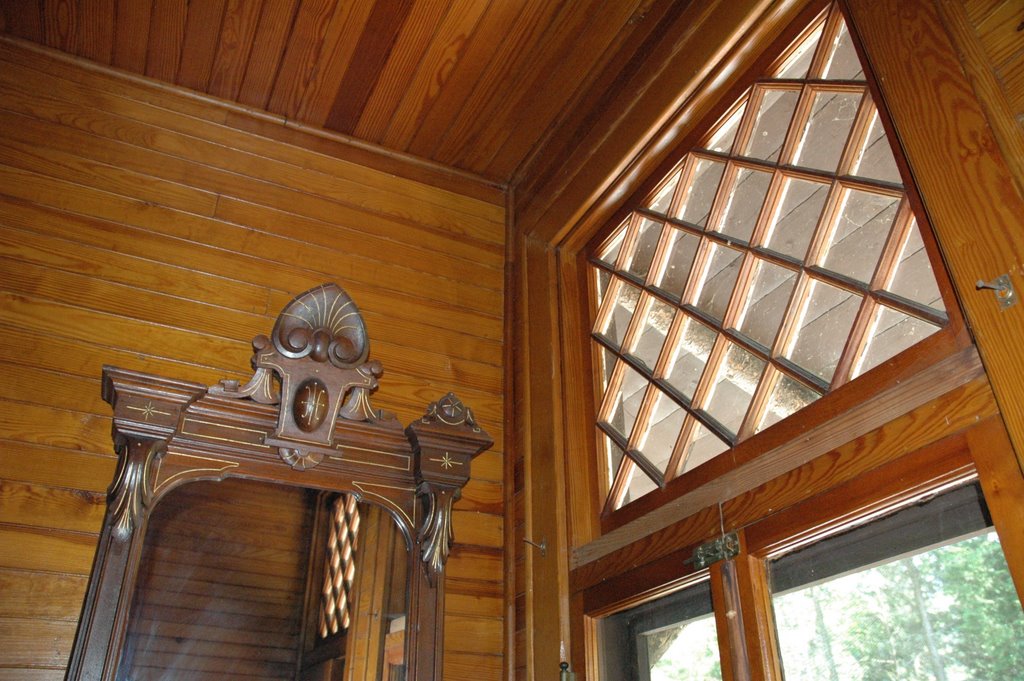
George Burnap, well known regional builder of Adirondack rustic camps, built the camp in a style reflecting the work of William West Durant, pioneer of the Great Camp style. Locals talked about the unique design of the windows, which included an unusual hinge allowing each window to be raised up an inch out of a protected groove before opening. When each window was closed, it slid back down into the original position, providing a tight fit and insulation in this seasonal house. Marylee Armour in Heartwood, her biography of W. Donald Burnap, George Burnap's son, and David Beetle's book Up Old Forge Way, specifically mention facts about Mr. Sylvester, the building of the camp, and details about the boathouse. The Adirondack syle buildings included:
1. The Camp
2. The Wood Shed
3. The Boathouse
4. The Lean-to
5. The Garage
6. The Pump House
7. Workers barracks for the crew and storage of building supplies.
Treated hemlock bark shingles were used as the exterior building material on some of the buildings, including the main lodge. Some of the camp's original furniture was manufactured in the workers' barracks, including the large dining room table with multiple leaves seating 10 at its greatest size, dining room chairs, a large credenza for the dining room, end and side tables, footstools, umbrella stand, and custom bookshelves in the living room. In addition, each bedroom has a custom built chest of drawers, writing desk, cabinet and luggage rack. The largest bedroom had two luggage racks. All of the furniture was designed in the arts and crafts style and had signature details matching the rustic aura of the camp. Canvas wall covering separates the distinctive beam construction of the downstairs. The canvas was originally a light brown color but was repainted white when Syracuse businessman Albert and Dorothea Rosenthal Gordon acquired the property in 1953.
According to local stories, the three story boathouse was used as quarters for the Sylvester family servants and guests, and there was a small gasoline engine driven sawmill on the ground floor. Mr. Sylvester proudly sported a large launch, which he generously used to pick up neighbors and transport them to church and other places on the lake. He also planted spruce trees that fill the property.
In 1939, according to Bobbette Rosenau, whose family rented Seymour Point from the Estate of James Horatio Seymour, after the deaths of Mr. and Mrs. Sylvester, and whose family had a camp on Fourth Lake, The Boulders, now owned by Lorraine Rosenau Alexander and Ben Alexander, the boathouse burned down. A fire truck came to put out the fire and broke the dock when it drove out on to it to douse the flames. The camp and other buildings were saved, but the magnificent boathouse was destroyed. It was never rebuilt in the grand style in which it was originally constructed, with a large wrap around porch on the upper level, several slips for boats, and quarters upstairs for guests and servants.
Subscribe to:
Posts (Atom)